The ballot
Four parties. One choice.
This is the order the parties appear on the paper. Your preferences can be different.
USSR
United School Socialist Republic — Open Budget, Fair Canteen, Late Library, Everyone Clubs
Independents
Independent candidates standing alone, without a party platform
Student Alliance
A cross-campus coalition focused on shared events
Future Front
A reform-focused group campaigning on smaller changes
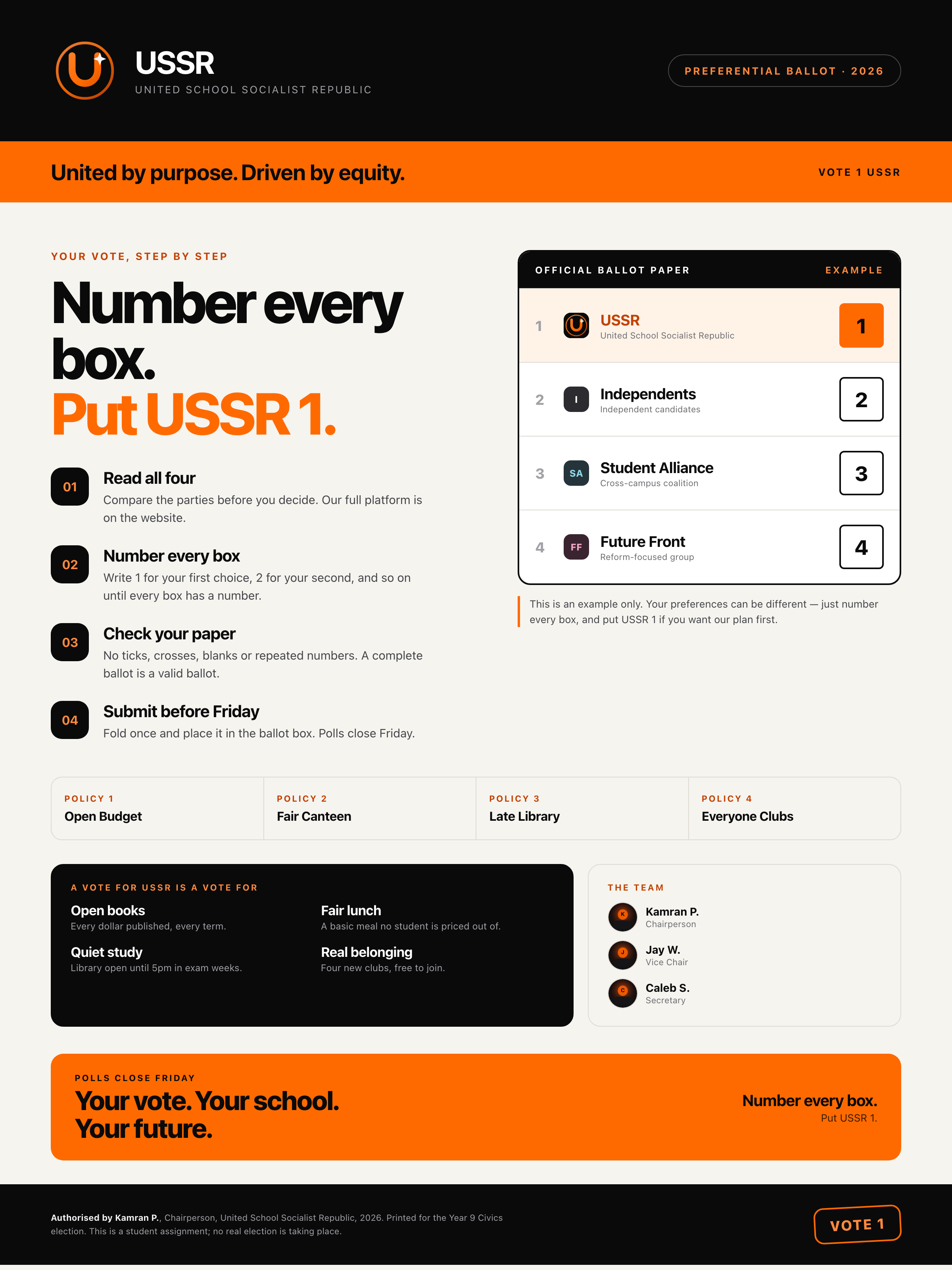
How to vote card
Everything you need
on one page.
Designed to be printed, pinned up or handed out. It includes the ballot order, a worked example, our four policies and the official authorisation.
Civics note
Parties and independents
In Australia, political parties group candidates around a shared set of policies. Independent representatives stand on their own and are not bound by a party platform. Both appear on the same ballot, and voters can rank them in any order.
A party makes its platform easy to compare. An independent asks voters to judge the person. This election gives you both options.
Civics note
How preferences work
You write 1 next to your first choice, 2 next to your second, and so on until every box has a number. If no candidate has a majority of first preferences, the lowest candidate is excluded and their votes flow to the next preference.
That is why a complete ballot matters: your vote can still help decide the result after your first choice is eliminated.
Read
Compare all four platforms before you decide.
Number
Write 1 for USSR, then 2, 3 and 4 in every remaining box.
Check
No ticks, crosses, blanks or repeated numbers — those can spoil the ballot.
Submit
Fold once and place it in the ballot box before Friday.